

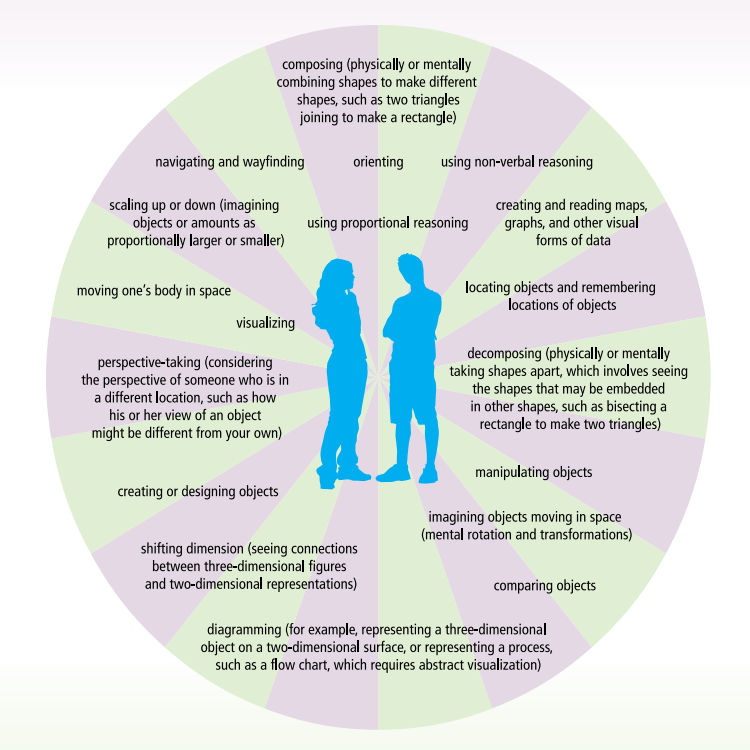
Spatial intelligence (spatial reasoning or visual-spatial ability) is a subgroup of reasoning skills that allow us to visualise spatial images in our heads and mentally manipulate them. This ability helps us to think about objects in three dimensions and to make inferences about those objects from the limited information available to us.
“Spatial thinking, or reasoning, involves the location and movement of objects and ourselves, either mentally or physically, in space. It is not a single ability or process but actually refers to a considerable number of concepts, tools and processes.”
National Research Council, 2006

Why is Spatial Reasoning Important?
We use spatial reasoning in many everyday activities, such as:
- Navigating with a map.
- Parking the car in a parking lot.
- Predicting where the ball will land when playing ball games, such as tennis, basketball, or soccer.
- Figuring out how many items are able to fit into a box of a certain size.
Spatial reasoning helps children with activities, such as:
- Reading – children need to know that certain shapes, like “w” and “m” and “6” and “9,” can have different meanings depending on how they’re rotated on the page.
- Math – trigonometry and calculus require the ability to imagine an object rotating in space.
- Sports and physical activity – to catch a ball, children need to gauge the speed and distance of the ball in flight and adjust their movements accordingly.
- Everyday activities – like using a mirror to comb their hair and tying their shoelaces.
Spatial reasoning skills are also important in many careers. Here are just a few examples:
- Architects need to be able to visualise 3D spatial orientation when designing new buildings and translate this mental image into a two dimensional drawing.
- Engineers need to be able to visualise how individual parts of a machine work together in order to solve problems.
- Medical doctors must be able to interpret X-ray images and other scans.
- Surgeons need to be able to visualise the positions of body structures as they perform their surgical procedures.
- Astronomers must be able to visualise the arrangement and motion of the planets in solar systems.

Research Links Spatial Intelligence with Future Success in Reading and Math
In education, research supports the link between spatial reasoning and future success in reading and maths. Not only are spatial reasoning and mathematical thinking intimately linked, but spatial thinking is also an important predictor of achievement in STEM careers.
Even in babies spatial can predict later math skills:
Spatial reasoning measured in infancy predicts how children do at math at four years of age, finds a new study. It provides the earliest documented evidence for a relationship between spatial reasoning and math ability.
Science Daily
In another study from Michigan State University, researchers found that even as little as 20 minutes of training in spatial reasoning can improve students’ maths abilities. According to Kelly Mix, one of the study’s researchers, spatial training “primes” the brain to better tackle calculation problems.
Games and Activities to Improve Spatial Reasoning Skills
The good news about spatial reasoning abilities is that it can be improved. The following are some activities we can introduce to our children to help them develop their spatial reasoning skills.
1. Master-Builder Game
Encourage the use of precise spatial language whenever possible. Studies have demonstrated that children who have been taught spatial language do better in spatial tasks compared to children who have not. Examples of spatial words include words related to location, distance, orientation and direction (e.g. left, right, over, under, above, below, middle, parallel, tall and short). Activities like the Master-Builder Game are useful for developing spatial language.


How the game works:
- Number players: 2 – a master and a builder.
- Without being able to see each other, the master creates a design or pattern with objects, like blocks (for example, we used LEGO). The master is then required to give the builder verbal instructions to recreate the design.

2. Sliding Block

Sliding Block – the goal of this game is to move the blocks around and free the red block. You may already have noticed that this is very similar in concept to the Think Fun Game Rush Hour where the goal is to free the red car from the traffic jam:


Aside from developing spatial reasoning (the ability to visualise blocks on a grid), Sliding Block is also good for encouraging problem-solving as children figure out how to reposition the blocks to free the red one. It helps them learn to analyse and reason with two dimensional shapes and their attributes.
3. Point of View Spatial Reasoning Game


The Point of View Spatial Reasoning Game allows players to practice their spatial reasoning skills through fun, challenging, interactive activities through 3 activities:
- Explore – Learn about the game mechanics and 4 different points of view.
- Vantage Point – See a top view and side view of objects and choose the matching side view.
- Make a Scene – Move the top view objects to match the side view.
Players progress through activities, which get increasingly harder as each level is mastered. Challenges are also timed and players are encouraged to improve on their best times.
4. Tangrams and Other Puzzles


Tangrams and other similar puzzles are terrific for developing spatial awareness:
5. Board Games
Board games that require visualisation skills:
- Chess
- Rumis – 3D Tetris-like board game.
- Connect Four – first player to get four in a row wins.
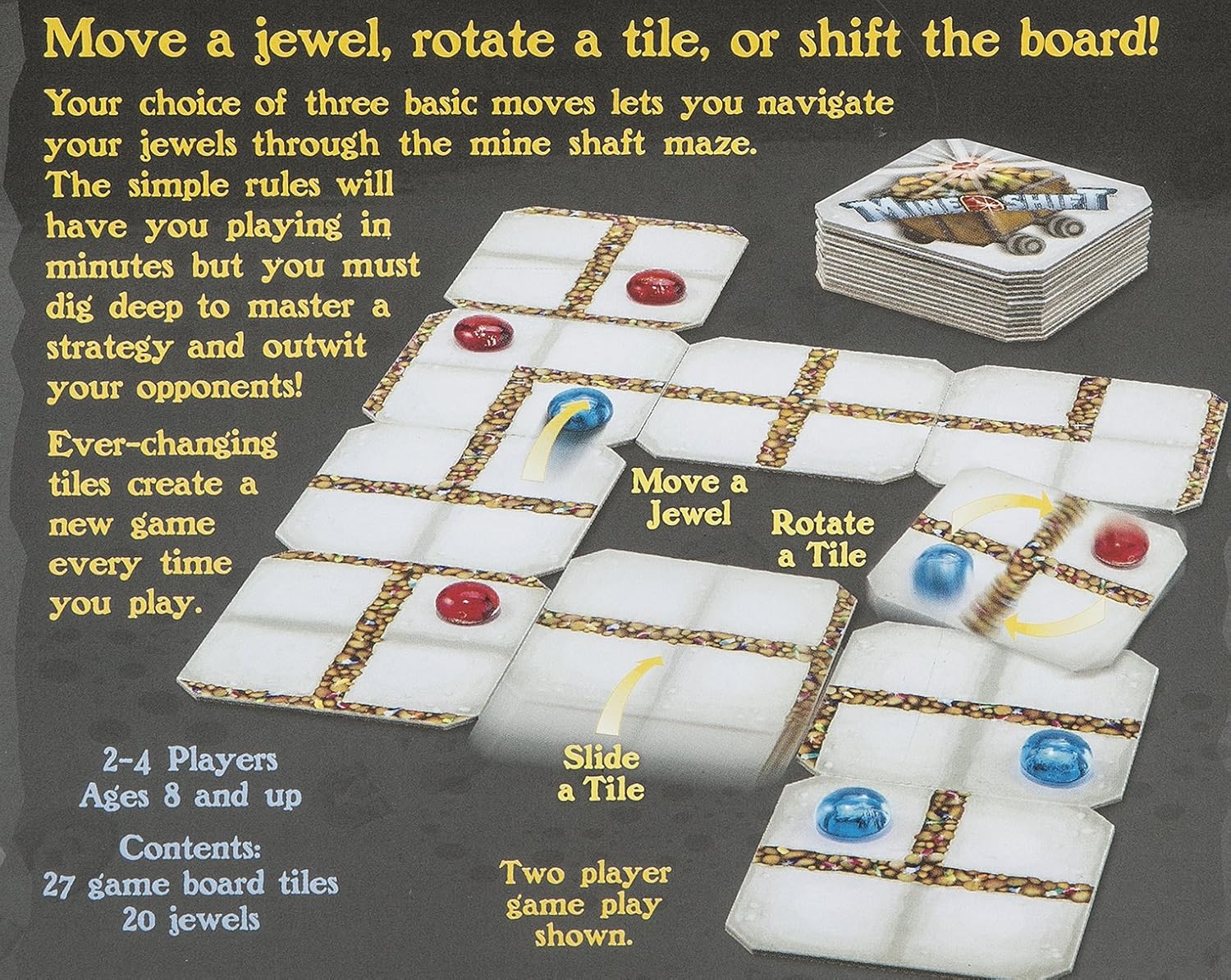
- Indigo – collect as many gems as possible by placing and rotating hexagonal tiles to draw the gems toward you.


- Battleship – try to sink your opponent’s battleships before they sink yours.


- Morphology – similar to charades except that you need to use sticks, beads, cubes, people, strings, and circles to make something to represent that word.


- Blokus – another tetris-like game.


- Labyrinth – move through an ever changing maze to collect treasures.


- Rummikub – a tile game similar to Gin Rummy but a whole lot more fun.


- Hive – similar to chess with the goal being to surround your opponent’s queen bee.


6. LEGO and Other Building Toys


LEGO sets are often criticised for removing the imagination from building, but following the instruction manuals for LEGO requires spatial reasoning skills as the 2-D images are translated to the 3-D object being built. Other building kits offer similar benefits:
- Magformers
- Engino – for budding engineers
- Arckit – for budding architects
7. Perspective Activities
Any activities that require translation of perspective are also great for training spatial reasoning. For instance:
- Controlling a remote control car on a race track.
- Coding with drones and robots, like the Code and Go Robot Mouse.
More Activities for Spatial Reasoning Development
- Activities that require the interpretation of maps, like orienteering are also great for developing spatial reasoning skills.
- Artistic activities like photography and drawing.
- Hobbies that involve the manipulation of 3D objects, like carpentry, pottery, metalwork, and model-making.
- Activities on wheels where the kids are in the control seat, like go-karting, bike riding, or skateboarding.
- Climbing activities such as monkey bars, rock climbing, or tree climbing.